



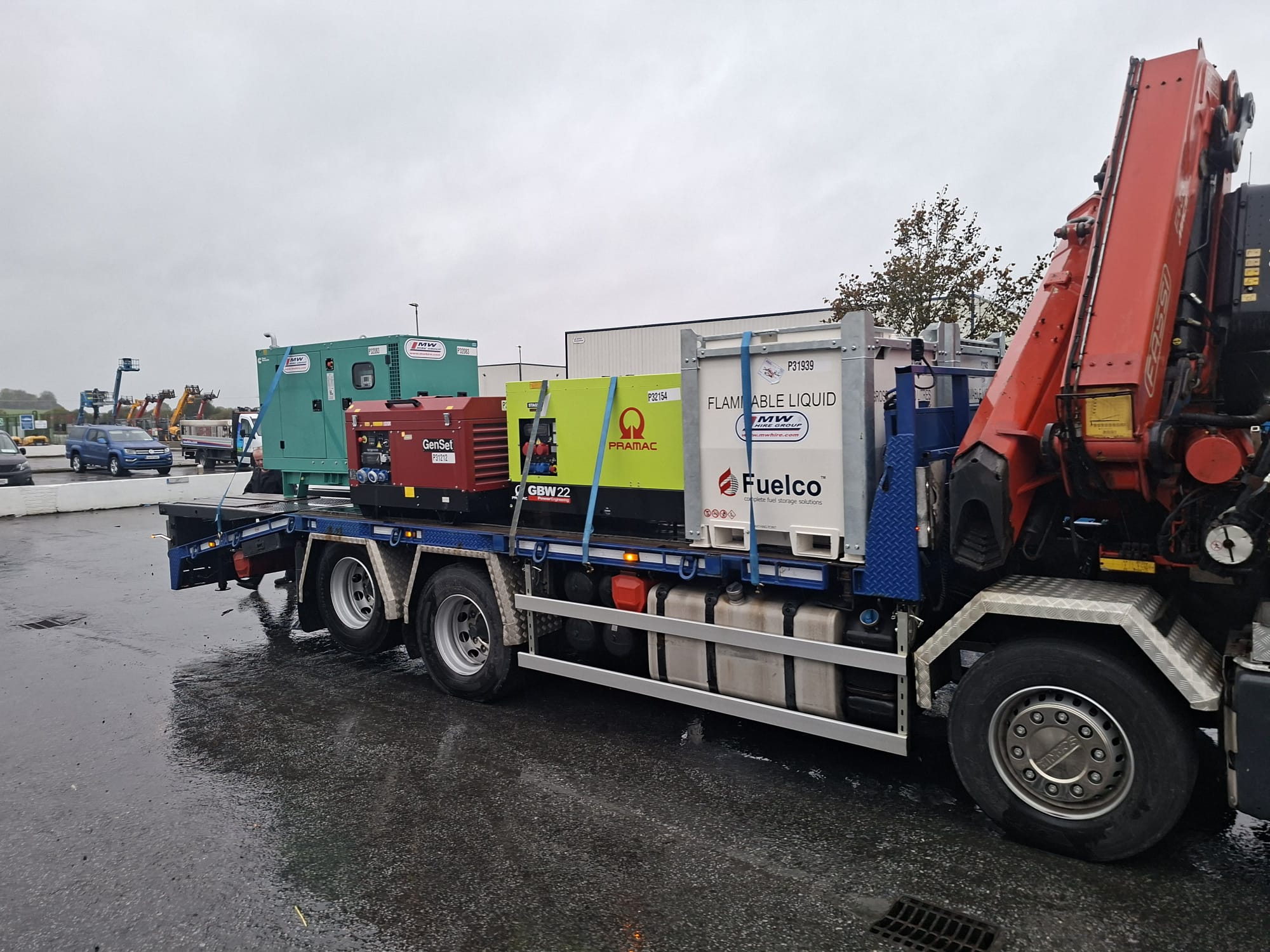
Generators of all Shapes and Sizes heading to there new home in the West!
Published:
How to Pick the Right Generator Size for Your Job (Without Guesswork)
Choosing the right generator size is one of the fastest ways to keep a job moving, protect your equipment, and avoid costly downtime. Too small, and you’ll trip breakers, stall motors, or damage sensitive electronics. Too large, and you’ll overpay in fuel, rental costs, and maintenance for power you never use.
This guide walks you through practical generator sizing—whether you’re powering a jobsite, a mobile service truck, an event setup, or temporary backup power. By the end, you’ll know how to estimate the right kW (kilowatt) or wattage generator for your load with confidence.
Generator Sizing Basics: Running Watts vs. Starting Watts
Most generator sizing issues come down to misunderstanding two numbers:
- Running watts (continuous watts): The power needed to keep equipment operating once it’s running.
- Starting watts (surge watts): The extra burst of power needed when motors start (common with pumps, compressors, saws, and HVAC).
Your generator must handle the highest combined demand that occurs at any moment—usually when one or more motor-driven tools start while other loads are already running.
Step-by-Step: How to Calculate the Generator Size You Need
1) List everything you plan to power
Start with a simple checklist of tools, appliances, lighting, battery chargers, and specialty equipment. Be specific—one “saw” could mean a small circular saw or a larger table saw with very different requirements.
2) Find the wattage for each item
The most accurate source is the equipment label (nameplate) or owner’s manual. If you only have amps and volts, you can estimate watts:
Watts = Volts × Amps
Example: A 120V tool pulling 8 amps uses roughly 960 watts (120 × 8).
3) Separate motor loads (surge) from resistive loads
Resistive loads (heaters, incandescent lighting) are straightforward: starting watts are usually close to running watts.
Motor loads (compressors, pumps, power tools) often need 2–3× their running watts for a fraction of a second at startup. Some hard-start loads can surge higher.
4) Add up running watts, then account for the largest starting surge
A practical approach for generator sizing is:
- Add total running watts for everything that could be on at the same time.
- Add an allowance for the biggest single surge (or the likely combined surge if multiple motors start together).
If your crew typically starts tools one at a time, you can size closer to the largest single surge. If multiple motors can kick on automatically (pumps, HVAC, refrigeration), plan for a higher surge requirement.
5) Build in headroom (don’t size to the exact number)
For most jobs, plan at least 20–25% capacity above your calculated need. This protects against nuisance trips, accommodates future tools, and helps the generator run cooler and more efficiently.
Common Wattage Ranges for Jobsites and Temporary Power
Exact requirements vary by brand and model, but these ranges can help you estimate quickly:
- Work lights (LED): 20–200W each
- Battery chargers: 100–1,000W
- Circular saw (7-1/4"): ~1,200–2,000W running (higher surge)
- Miter saw / table saw: ~1,500–3,500W running (higher surge)
- Air compressor (small/medium): ~1,200–3,000W running (2–3× surge common)
- Pressure washer (electric): ~1,500–3,500W running
- Sump/transfer pump: ~800–2,500W running (high surge)
- Space heater: ~1,500W (typically minimal surge)
- Welding machine: varies widely; confirm input requirements
When in doubt, size from the nameplate, not a generic chart—especially for compressors, pumps, and welders.
Quick Example: Sizing a Generator for a Small Crew
Let’s say you need to run:
- Two LED work lights: 2 × 100W = 200W
- Battery charger: 500W
- Circular saw: 1,800W running (assume 3,000–4,000W surge)
- Air compressor: 2,000W running (assume 4,000–6,000W surge)
Total running watts = 200 + 500 + 1,800 + 2,000 = 4,500W
Now account for starting. If the compressor is the largest surge load, and other items are already on, you might need:
4,500W running + (additional surge allowance)
If the compressor surges to 6,000W at start, you don’t add the full 6,000W on top of 4,500W—because the 2,000W compressor running is already included. You’d add the extra surge above running:
Surge “adder” = 6,000W − 2,000W = 4,000W
Estimated peak = 4,500W + 4,000W = 8,500W
With 20% headroom, you’re in the range of a 10,000W (10kW) generator for comfortable operation.
Don’t Forget Voltage, Outlets, and Phase
Generator sizing isn’t just about total watts. The generator also has to match how your equipment connects:
- 120V vs. 240V: Some tools and pumps require 240V. Confirm your generator has the correct receptacles and capacity at that voltage.
- Single-phase vs. three-phase: Many commercial sites require three-phase power for certain equipment. Make sure the generator output matches.
- Circuit limits: A “10kW generator” can still overload a single 20A receptacle if you plug too much into one circuit.
Real-World Factors That Change Generator Output
Even correctly sized generators can struggle when conditions reduce output. Plan ahead for:
- Altitude and heat: Engines produce less power at higher elevations and in high temperatures (derating). If you work in these conditions, you may need the next size up.
- Long extension cords: Voltage drop can cause hard starts and overheating. Use properly sized cords and keep runs as short as practical.
- Power quality needs: Sensitive electronics, controls, and some battery systems may require inverter generators or low-THD output for cleaner power.
Choosing Between Portable, Inverter, and Towable Generators
Once you’ve estimated wattage, match the generator type to the job:
- Portable generators: Great for smaller loads and flexible deployment. Ideal for light construction, service work, and temporary needs.
- Inverter generators: Best for clean power, variable speed efficiency, and quieter operation—excellent for electronics, events, and mixed loads.
- Towable/jobsite generators: Built for higher kW demands, longer run times, and rugged use on active sites.
A Practical Generator Sizing Checklist
- Confirm all equipment running watts from nameplates or manuals.
- Identify motor loads and estimate starting surge (often 2–3× running).
- Calculate peak demand and add 20–25% headroom.
- Verify 120/240V requirements, plugs, and circuit capacity.
- Consider environment (heat/altitude), cord lengths, and power quality.
Need Help Picking the Right Size?
If you share your equipment list (tools, amps/volts, and whether items run at the same time), we can recommend the best generator size for your job—portable, inverter, or jobsite-ready—so you get reliable power without overspending.
Bring your load list to your next order or call us with the nameplate details, and we’ll help you match the right generator to your timeline, site conditions, and budget.